
When the Software Gets Cheap, Trust Gets Expensive
What Harry Stebbings, the Sphere, and a can of water know about the one moat AI can't drain

A few years ago the hardest part of building a software company was building the software. That difficulty was the moat. You burned two years and a few million dollars getting a product to actually work, and the pain of that was the thing keeping the next ten people from doing exactly what you’d done.
That moat is draining fast.
I can sit down on a Saturday now and stand up a working version of something that would’ve taken a seed-funded team a full quarter to ship in 2021. So can you. So can the seventeen-year-old in Jakarta who watched the same tutorial I did. When everyone can build the thing, building the thing stops being the advantage.
So if the product isn’t the moat anymore, what is? That’s the question this whole newsletter is built around.
My answer, after building Trarian in one of the loudest corners of the AI market, is trust. Not trust the soft virtue. Trust the asset — the hardest, most expensive, least copyable thing left on the board. And the people who understood this first weren’t software founders. They were selling podcasts, energy drinks, and canned water.
I’m not theorizing about this. I’m doing it.
I run an AI company and I write this thing every week. Those two activities are the same project.
My whole career has been underwriting assets nobody else could price. Patents at RPX, including the Rockstar/Nortel deal. Insurance risk at ZestyAI. Legal AI at Paxton. The throughline is that I’ve watched category after category get commoditized, and I learned to ask one question early: when the obvious version of this goes free, who still gets paid?
Almost never the team with the best tech. Best tech is a six-month lead, and six months is nothing. The one who still gets paid is the one the market already believes — whose name is shorthand for this won’t waste my time. That belief takes years to build and can’t be cloned by a competitor with a bigger model and more GPUs.
This blog is me doing the exact thing I’m about to tell you to do. Writing in public, slowly, no paywall, because the audience and the trust are the actual product and the company is what monetizes the attention later. Which brings me to the best living proof of the strategy.
Harry Stebbings Built the Audience Before He Built the Fund
In 2015 a teenager in the UK with no money and no connections started a podcast called The Twenty Minute VC. He interviewed venture capitalists. That was the whole business. He had nothing to offer them — no fund, no deal flow, no checks — just a mic and good questions and the discipline to ship every single week.
Ten years on, 20VC is one of the most-listened-to shows in tech and Stebbings runs a venture fund that’s raised on the order of several hundred million dollars.
Venture is about the hardest market on earth to break into. The incumbents have decades of relationships, brand-name partners, and billions already committed. A nineteen-year-old with a podcast should not be able to walk in and take share from them. And yet founders now route deals to him, sometimes over firms with longer track records and deeper pockets, because his money arrives stapled to the single biggest microphone in the industry.
He ran the model backwards. The normal path is: raise a fund, make good bets, build a reputation over a decade or two, and eventually a few founders come find you. Stebbings built the reputation first, in public, with content, and the fund was almost a formality once the audience existed. Trust came first. Capital followed it.
People wave this off as “he got lucky with a podcast.” The podcast wasn’t the lucky break. The podcast was a ten-year unpaid compounding deposit into an account labeled the market knows me and believes me. By the time he wanted to spend that down, the hard part was done.
I Pulled the Comps Expecting to Debunk This. I Couldn’t.
There’s a line going around that live-events and experience businesses command better multiples than software. So I pulled the actual public comps. It’s stronger than I thought, and how it got that way is the part that matters.
Here’s where a handful of live-experience and sports-IP names sit against three mid-cap SaaS companies, current multiples as of the June 18, 2026 close:
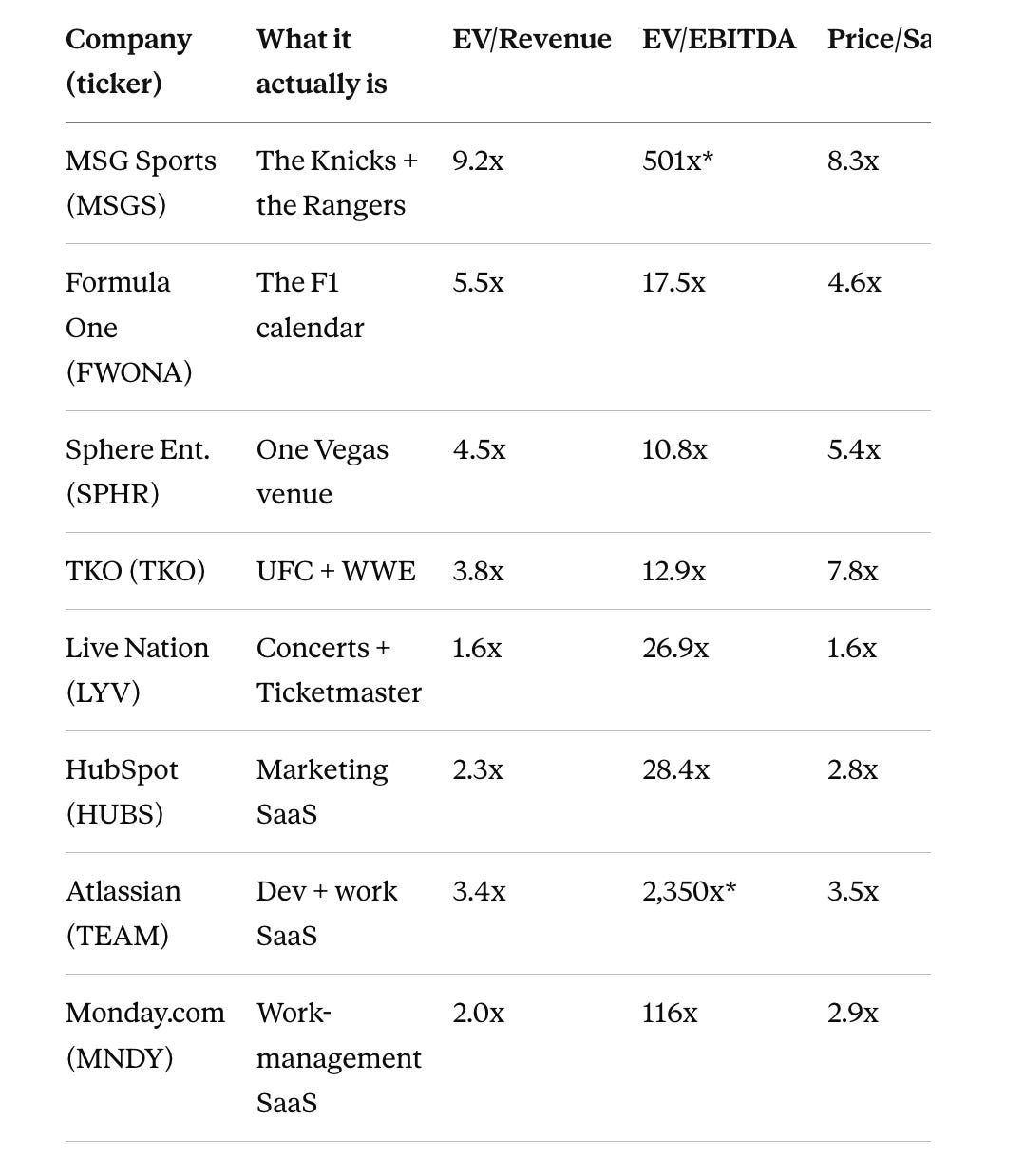
EBITDA so small the multiple is noise — ignore those two. Source: Yahoo Finance valuation pages.
Run your eye down EV/Revenue. The experience names cluster around four to nine times revenue. MSG Sports — which is, functionally, two New York teams in a holding company — trades at nine times sales. Formula One at five and a half. The Sphere, a single building, at four and a half.
Now the software column. HubSpot, Atlassian, Monday. Real companies, real revenue, the SaaS that was supposed to own the next twenty years. Two to three and a half times revenue. The median experience name trades at roughly double the median software name. The concert promoter beats the cloud platform.
Rewind a year and a half. Atlassian traded at 11.5x sales. Monday at 13. HubSpot at 11. Premium software, priced like premium software. Today those same three are at 3.5, 2.9, and 2.8. That’s not a drift. That’s a roughly 75% compression in about a year, and the market caps fell with it — Atlassian from $56B to $21B, Monday from over $12B to under $4B. The market started asking the question I opened this piece with. If AI makes software cheap to build and trivial to copy, what’s a SaaS moat actually worth?
The experience names held. And the reason is structural, not sentimental. A sports franchise is a legal monopoly on a city’s emotional attachment — you cannot vibe-code the Knicks. F1’s calendar is a fixed number of races nobody else is allowed to run. The UFC and WWE libraries inside TKO are scarce in a way a feature set never is. AI will write you a project-management tool over lunch. It cannot manufacture a thing fifty thousand people will pay to stand in a room for.
An honest caveat. I picked SaaS names the market is actively scared about; Microsoft and ServiceNow still trade rich, so the real claim isn’t “all software is cheap.” It’s narrower than that: the software the market believes AI can eat is being repriced toward commodity, while businesses built on scarce experiences and owned IP keep their premium.
Red Bull and Liquid Death Are Media Companies Wearing a Beverage Costume
Red Bull figured this out decades before it had a name.
People call it an energy drink company. It is not. It’s a media and sports company that funds itself by selling a can of caffeine and sugar that costs almost nothing to produce. Red Bull owns Formula One teams. It put a man at the edge of space and let him jump, live, in front of tens of millions of people. It runs a full media house — films, magazines, a global stable of sponsored athletes doing things you can’t look away from. The drink is the merch. The content is the company. Because the content built a real identity, Red Bull can charge a premium for something that is, chemically, a commodity in a can.
Liquid Death ran the same play, louder and faster, and proved it works from a standing start.
They sell water. Water — the thing that comes out of your tap for free, the most commoditized product imaginable. And they’ve built it into a brand worth north of a billion dollars by treating the company as an entertainment property first and a beverage second. The death-metal aesthetic, the “Murder Your Thirst” line, the absurdist stunts, the fact that people buy and wear the merch — none of that is decoration on a water business. That is the business. The water is how they bill an identity people want to belong to.
Both of them understood something most software founders still don’t. In a commodity category the product can’t be the differentiator, because by definition it’s the same as everyone else’s. So the brand carries the whole load. Red Bull and Liquid Death just got there first, in a category where the commoditization happened a hundred years ago.
Software is becoming that category right now. AI is doing to “an app that does X” what bottling did to water. The thing that looked like a gimmick when a water company did it is about to look like basic survival for AI companies.
Cluely Is the First Wave, Not the Weird Exception
You can already watch it happen.
Cluely is, on paper, an AI tool that helps you in real time during calls, interviews, and sales conversations — a quiet assistant in your ear. As software, it’s replicable. A dozen teams could ship a version of it next month. The real-time overlay is not the hard part anymore, which is the problem with basically every AI product right now.
So the founder didn’t fight on the software. He turned the company into a piece of media. He built the whole thing on deliberate controversy — the “cheat on everything” framing, the manufactured outrage, the founder as a character people argue about online. The provocation is the distribution. By the time a cleaner competitor shows up, Cluely already owns the conversation and a16z has already wired the check.
You can hate the bit. I’m not defending the taste of it. I’m pointing out the structure: it’s the Red Bull play with an AI product where the energy drink used to be. The software is the can. The attention is the company.
And this becomes the default, not the oddity. We’re going to see a wave of AI companies that are media and events businesses first, with the model bolted on as the billing layer. The founders who win the next few years won’t have a half-step-better benchmark. Benchmarks reach parity in months. They’ll have an audience that trusts them and an identity people want to stand next to.
People Reach for Trusted Brands Because They’re Drowning
Underneath all of it is something more human than the market math, and it’s why the whole thing holds.
When people are buried in choice, they stop evaluating. They can’t keep up. Too many options, not enough hours, and now every option is wrapped in confident AI-written copy that reads exactly as polished as every other option. So people quit evaluating and start belonging. They pick the brand that already feels like theirs and they stop looking.
That’s what a trusted brand really does in a noisy room. It’s not a quality signal. It’s a relief from having to decide. When I buy from a brand I trust I’m not just buying a product — I’m buying my way out of vetting twelve alternatives, and I’m buying a small piece of who I want to be. The Liquid Death drinker is making a statement. The founder who takes Stebbings’ money is aligning with what his name means in the market.
A brand is an extension of identity. People reach for the ones that feel like an extension of theirs, and they reach hardest when the noise gets loud enough that real evaluation becomes impossible. The noise is about to get much louder, because AI just handed everyone the power to produce infinite polished, confident, indistinguishable content. The signal-to-noise ratio is collapsing. When everything sounds equally good, the only thing left to trust is the source.
That’s the game now. Not the best product — the most trusted name attached to a good-enough one.
So if you’re pouring everything you have into being marginally better on a benchmark, you’re polishing the one thing that’s about to be free. The benchmark lead evaporates. The trust compounds. One of those is a moat and one of those is a press release.
I started writing this before I had anything to sell, when nobody was reading, because I’d rather spend the next several years making slow deposits into an account no competitor can repossess.
The Sphere is one building in a desert, and the market pays more for it per dollar of revenue than for software that runs the actual internet.